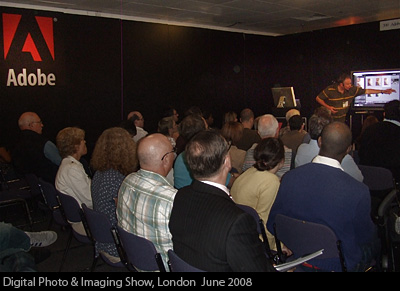
I was minding my own business at the trade show and simply looking forward to watching various presentations – but 5 minutes after saying hello to Adobe, I was demonstrating Lightroom
I don’t like to waste time looking for pictures. I want to be taking them, or working on them, using or admiring them – anything other than trying to find where the damn things have gone. So before I used Lightroom, I was well-known in the iView MediaPro and Extensis Portfolio communities. These cataloguing programs and the field of digital asset management came naturally to someone with a background as a financial manager and then financial IT consultant as I had always focussed on drilling into and getting information out of database-driven business systems. So once I moved from film to digital and was rapidly accumulating many thousands of pictures, I just applied those skills and experience to organising my work.
This background in managing business information distinguishes my approach to Lightroom from digital photography authors who trained as graphic artists or photographers and came to Lightroom from Photoshop. Although I used Photoshop years before Lightroom was released, my perspective is not to teach Lightroom as another kind of Photoshop but as an entirely different kind of tool – one that is as much about managing pictures as it is about processing them. And, again unlike Photoshop, my approach is to focus on Lightroom handling images in the plural.
I also find a lot of tutorials and writing about Lightroom to be pretty bland. Are people really helped by being told things are “easy”, “awesome”, and being splattered with exclamation marks? Lightroom is not a difficult program in comparison to some I might name, but neither does learning it come without the demand for some effort and clear thought. You don’t mind that though, do you?
A bit more clarity and even provocative advice? Just look at Photoshop – after two decades, tools from its stone age still keep getting dug up and made to seem very convincing when you first encounter them on a shiny new web site or in a freshly-printed book. I don’t dispute that an old technique may still provide quality results, but how are you to know that it is long-obsolete and that by comparison with newer methods it is cumbersome, creatively-limited – and really best-forgotten. Clarity, and occasionally a sharp tongue, will do Lightroom users good.
Lightroom is already generating a similar fog of outdated wisdom, yet when sloppy advice is challenged the response is evasive – “different strokes for different folks” or “your mileage may vary”. The trouble is, when you do think through a problem and line up all the factors, there is very often one right way to do something. Why be afraid to say so?
Equally, don’t underestimate how much I hope some readers are simply provoked into examining their own needs and decide to do precisely the opposite of what I advise. I’m perfectly happy to play the devil’s advocate.